



Table of Content
5 Best Carry-On Bags for Maximum Packing Space in 2026

The best carry-on bag for maximum items is not necessarily the model with the highest advertised capacity. A roomy bag must also fit your airline’s size limit, leave enough weight allowance for your belongings, and provide an interior that is easy to fill.
For most travelers, the LEVEL8 Voyageur offers the best balance of usable space and structured organization. Travelers who want expandable storage may prefer the LEVEL8 Adventure, while the July Carry On Max offers greater stated capacity at the cost of broader airline compatibility.
Best Carry-On Bags for Maximum Space at a Glance
The table below separates usable everyday capacity from expansion that could push a bag beyond an airline’s limits. Travelers who want to compare more sizes, structures, and materials can browse LEVEL8’s complete range of carry-on luggage.
| Product | Recommendation | Dimensions | Capacity | Weight | Main Space Advantage | Main Limitation |
|---|---|---|---|---|---|---|
| LEVEL8 Voyageur Carry-On | Best overall | 21.3 × 15.1 × 9.8 in | 43L | 8.1 lb | Flat interior created by a wide handle | Wider than some airline limits |
| LEVEL8 Adventure Carry-On | Best expandable top-opening case | 21.3 × 15.4 × 10.2 in | 45L; 50L expanded | 9 lb | Deep compartment with 5L expansion | Large even before expansion |
| July Carry On Max Expandable | Best for maximum stated capacity | 22.99 × 15.98 × 9.02 in | 50L; 62L expanded | 8.2 lb | Very high capacity plus a packable tote | Exceeds many standard carry-on limits |
| Travelpro Maxlite 5 Carry-On Spinner | Best lightweight soft-side option | 23 × 14.5 × 9 in | 46L | 5.4 lb | Low empty weight and flexible packing | Overall height exceeds many limits |
| CabinZero Classic 44L | Best maximum-capacity backpack | 20.1 × 14.6 × 7.9 in | 44L | 1.7 lb | No wheels or trolley system taking up space | Full weight must be carried |
Dimensions include external components where published by the manufacturer. Expansion usually increases a bag’s depth, so an expanded case should not automatically be treated as cabin compliant.
The carry-on that holds the most in practice is the one that converts its permitted exterior dimensions into unobstructed interior space. July offers the largest stated capacity here, but the LEVEL8 Voyageur provides a more practical balance for travelers who want a hard-shell case without depending on an expansion zipper.
Our Top Picks for Carrying More Without Checking a Bag
Each recommendation solves a different packing problem. Some reduce internal obstructions, while others use expansion, low empty weight, or a wheel-free structure to increase what you can bring.
LEVEL8 Voyageur Carry-On — Best Overall for Flat, Usable Packing Space
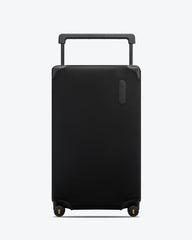
The LEVEL8 Voyageur Carry-On earns the top recommendation because its wide trolley system creates a flatter packing surface. Traditional telescopic rails often run through the center of a suitcase, leaving raised channels that make packing shoes, boxes, and rectangular cubes less efficient. Moving the handle structure toward the edges gives those items a more even base.
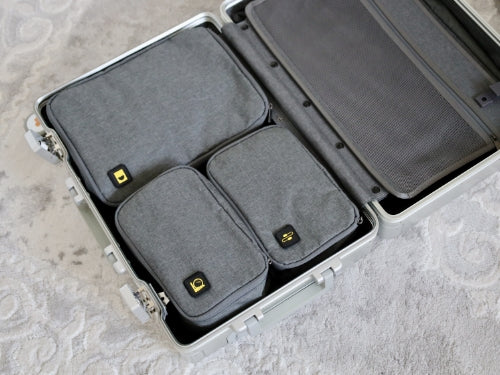
Its 43L capacity is generous for a 20-inch hard-shell carry-on. An internal compression system secures folded clothing, while two main compartments and a wet-dry pocket keep small or damp items separate. The German-made Makrolon polycarbonate shell adds structure without requiring a thick aluminum frame.
At 8.1 pounds, the Voyageur is not an ultralight suitcase, but it leaves more weight allowance than some feature-heavy hard cases. Its 21.3 × 15.1 × 9.8-inch dimensions need attention: the width and depth exceed the common 22 × 14 × 9-inch standard, so travelers should check their airline rather than rely on the “20-inch” label.
Best for: Travelers who want a structured hard-shell case with a flat interior for packing cubes, folded clothes, and other regular-shaped items.

LEVEL8 Adventure Carry-On — Best Expandable Top-Opening Option
The LEVEL8 Adventure Carry-On begins with 45L of capacity and expands to 50L, giving it more flexibility than the non-expandable Voyageur. Its top-opening structure forms one deep main compartment instead of two equally sized clamshell halves. A thick sweater, boots, or a bulky packing cube can sit deeper in the case without being divided across two sides.
Top access also needs less floor space. In a small hotel room, the lid can be opened without spreading the entire suitcase across the bed. A wide trolley system keeps the interior comparatively flat, and the compression panel helps stop stacked clothing from moving toward the opening.
The expansion zipper adds 5L, but that extra space increases an already generous 21.3 × 15.4 × 10.2-inch profile. The expanded mode works best as reserve space for purchases on the return trip, particularly when the traveler is willing to check the case if required.
Best for: Overpackers who carry bulky items, prefer a deep top-opening compartment, and want expansion as a backup rather than a guarantee of cabin compliance.
July Carry On Max Expandable — Best for Maximum Stated Capacity
With a 50L base capacity and 62L when expanded, the July Carry On Max posts the largest suitcase capacity in this selection. Its expansion panel adds 12L, and an included packable tote supplies another 20L as a separate bag. That tote is useful when an airline permits both an overhead carry-on and a personal item.
Those numbers need context. The suitcase measures approximately 22.99 × 15.98 × 9.02 inches, which is already larger than the 22 × 14 × 9-inch allowance used by many carriers. Expanding it increases the risk of a gate check further. The suitcase is therefore better understood as a maximum-volume case for selected airlines, not as a universally compliant carry-on.
A compression system helps control clothing, while the polycarbonate shell, reinforced corners, spinner wheels, and integrated TSA lock provide the features expected from a premium hard case. Its tracking lock can also connect with Apple Find My or Google Find Hub, although tracking does not affect packing capacity.
Best for: Travelers who prioritize maximum volume over broad airline compatibility and accept that a fully expanded case may need to be checked.
Travelpro Maxlite 5 Carry-On Spinner — Best Lightweight Soft-Side Carry-On
The Travelpro Maxlite 5 weighs only 5.4 pounds while providing a stated 46L capacity. That low starting weight can matter more than a few extra liters on airlines with cabin-baggage weight limits. Under a 10kg allowance, a lighter suitcase leaves roughly three additional pounds for clothing compared with an 8.2-pound case.
Its soft polyester body is more forgiving around irregular items than a rigid shell. Two exterior pockets keep documents or a light layer accessible, and a tapered 2-inch expansion panel adds flexibility while helping the packed case remain balanced.
The overall dimensions are 23 × 14.5 × 9 inches before accounting for added expansion depth. Although Travelpro positions it for many major US airlines, its height and width exceed the familiar 22 × 14 × 9-inch limit. A softer exterior can flex slightly, but an overfilled pocket or expansion panel may prevent it from entering a baggage sizer.
Best for: Travelers who want to devote more of their airline weight allowance to packed belongings and prefer the flexibility of a soft-sided suitcase.
CabinZero Classic 44L — Best Maximum-Capacity Carry-On Backpack
The CabinZero Classic 44L eliminates spinner wheels and telescopic rails, leaving more of the bag’s footprint available for storage. Despite its 44L capacity, it weighs only about 1.7 pounds. Its rectangular main compartment opens like a suitcase, making it easier to arrange packing cubes than in a narrow hiking pack.
At 20.1 × 14.6 × 7.9 inches, the bag is shorter and shallower than many wheeled cases. Side compression straps help control its profile when it is not full, while top and side handles make it easier to lift into a compartment. A sleeve accommodates laptops up to 17 inches, though a large computer naturally takes space and adds weight.
The main compromise is carrying comfort under a heavy load. Forty-four liters of clothing, electronics, and toiletries can become tiring during a long airport connection. Travelers should consider not only whether everything fits, but whether they can carry it comfortably.
Best for: One-bag travelers who want a lightweight, wheel-free design and are comfortable carrying the entire load on their back.
What “Maximum Packing Space” Really Means
Capacity figures are helpful for screening products, but they do not provide a perfectly standardized comparison.

Stated Capacity vs. Usable Interior Space
A 45L case does not always hold more useful items than a 43L case. Manufacturers may calculate capacity differently, and internal components consume part of the apparent volume. Trolley rails, wheel housings, thick dividers, laptop pockets, and curved corners can leave small spaces that are difficult to fill.
A broad, rectangular compartment usually works well with packing cubes. A deep top-opening case handles thick or irregular items more easily. The best design depends on what occupies the space, not only on the number printed beside it.
Base Capacity vs. Expanded Capacity
Expansion creates room by increasing the case’s depth. It does not increase the airline’s permitted dimensions.
A bag that fits the overhead bin in its standard form may fail a baggage-sizer check once the expansion zipper is opened. Expansion works well as temporary flexibility during road or rail travel, or as return-trip capacity when checking the bag remains an acceptable fallback.
Volume vs. Airline Weight Limits
Some travelers reach the weight limit before filling the case. Shoes, cameras, toiletries, and electronics are dense, while sweaters take up considerable space without adding as much weight.
Empty suitcase weight therefore deserves a place beside capacity. Subtract the bag’s weight from the airline allowance to estimate how much payload remains. A 5.4-pound soft case may carry more permitted weight than a larger 9-pound hard case, even when its stated volume is lower.
How to Choose a Carry-On That Actually Fits More
A useful buying decision starts with the trip rather than the capacity chart.
Start With Your Most Restrictive Airline
Check the baggage rules for the airline and fare type you use most often. Measurements should include wheels, fixed handles, side feet, and filled exterior pockets. When several airlines are involved, use the smallest allowance as the buying limit.
Because baggage policies vary by airline, route, fare, and aircraft, review the current airline luggage size and weight restrictions before choosing a high-capacity case.
Match the Interior Shape to What You Pack
A flat hard-shell interior suits packing cubes and folded business clothing. Deep top-opening cases accommodate boots, jackets, and oddly shaped belongings. Soft-sided luggage offers flexible corners and exterior access, while a backpack removes wheel hardware in exchange for carrying the load yourself.
Treat Expansion as Insurance
If expansion is needed only after shopping on the return journey, it serves as useful insurance. If the bag must be expanded on every trip, its base capacity probably does not match your needs. Choosing a different structure—or checking luggage—will be more reliable than repeatedly risking a gate fee.
Compare Empty Weight Before Liters
A high-capacity bag can still be a poor choice when its shell consumes too much of the weight allowance. Calculate the remaining payload, then consider whether the handle, wheels, protection, and organization justify their weight.
How to Fit More Without Overstuffing the Bag
Efficient packing improves usable space, but it cannot change the airline’s size or weight rules. Following a consistent method for packing a suitcase efficiently can reduce wasted space without forcing the case beyond its intended shape.
- Compress soft, bulky clothing in packing cubes.
- Fill shoes with socks, cables, or other small items.
- Wear the heaviest shoes and outer layer during transit.
- Keep rigid objects away from expansion panels and curved corners.
- Place frequently used electronics in a personal item when the fare permits one.
Compression reduces trapped air, not weight. Pulling a zipper shut under heavy tension can distort a soft bag, strain its closure, or make a hard-shell case too deep for the baggage sizer. A properly packed carry-on should close without kneeling on it or forcing the zipper around a bulging corner.
Conclusion
The LEVEL8 Voyageur is the best overall choice for travelers who want maximum usable hard-shell space. Its wide-handle construction creates a flatter interior, making its 43L easier to use with packing cubes and folded clothing.
Choose the LEVEL8 Adventure when a deep top-opening compartment and optional expansion are more valuable than conservative exterior dimensions. The July Carry On Max delivers the highest stated volume, but it suits travelers willing to accept greater gate-check risk. Travelpro’s Maxlite 5 is the better option when empty weight limits how much can be packed, while the CabinZero Classic 44L maximizes a wheel-free backpack format.
Ultimately, the roomiest carry-on is not the one with the largest capacity claim. It is the bag that provides the most usable space while remaining within the size and weight rules of the airlines you actually fly.
Frequently Asked Questions
What is the largest carry-on size allowed by most airlines?
Many North American carriers use a limit around 22 × 14 × 9 inches, including wheels and handles. International and low-cost airlines may impose smaller dimensions or stricter weight limits.
Is a 45L carry-on too large for international flights?
It can be. Capacity does not determine compliance; exterior measurements do. Many 45L bags exceed at least one dimension used by stricter international carriers.
Do airlines measure carry-on bags with the wheels included?
Yes. Published overall dimensions generally include wheels, fixed handles, pockets, and other external components. Airlines assess the complete packed bag.
Does expanding a carry-on make it too large for the overhead bin?
Not always, but expansion commonly increases depth beyond the airline’s limit. Check the expanded dimensions rather than assuming that a carry-on remains compliant in both configurations.
Can a travel backpack hold more than a rolling carry-on?
A backpack can devote more of its exterior footprint to storage because it has no wheels or telescopic handle. Whether it is the better option depends on the airline’s limits and whether the traveler can comfortably carry the packed weight.

Leave a comment