



Table of Content
Best Travel Backpacks for Women: How to Choose for Comfort, Work, and Trips

The best travel backpack for women is not defined by color or a “women's” label. Fit, empty weight, shoulder-strap shape, capacity, and how the bag carries a realistic load have a much greater effect on comfort.
This guide explains how to choose a backpack for city travel, business trips, overnight packing, or use as a personal item—and how to evaluate unisex designs without assuming they fit every body the same way.
What Makes a Travel Backpack Work Well for Women?
No single measurement or “women's” label determines comfort. A useful evaluation looks at how the pack's proportions, straps, weight, access, and dimensions work together on the individual wearer.
Proportions that match the wearer
A backpack that extends too far below the waist or sits too high behind the head can feel awkward even when its capacity looks right. Compare the pack's height and width with your torso and shoulder width, then test it with weight inside.
Adjustable, comfortable shoulder straps
Strap shape matters because it affects the neck, chest, and underarm area. Padding should distribute pressure without becoming stiff or bulky. S-shaped straps can follow the upper body more naturally for some wearers, but there is no universal shape that fits everyone.
Manageable empty weight
A large travel pack encourages extra packing. Start with what you can comfortably carry for the longest walking portion of the trip, then choose capacity. A lighter bag does not help if its straps and back panel cannot support the load.
Access suited to the trip
A clamshell opening makes clothing easier to pack, while a top-loading design may work better for commuting. Quick-access pockets help with passports and phones. Laptop travelers need padding and a compartment sized for the actual device; this guide to travel-friendly laptop backpack features explains the protection and organization standards in more detail.
Dimensions that match how you fly
A backpack may be a carry-on on one airline and a personal item on another. Check complete dimensions and do not rely on capacity alone; two 30-liter bags can have very different shapes.
Choose the Backpack by Trip Type
A comfortable backpack can still be wrong for the job if its capacity or access does not suit the itinerary. Start with what the bag must carry and how long it will stay on your shoulders, then compare that use with LEVEL8's broader travel backpack guide.
City travel and commuting
Prioritize a compact profile, secure quick-access pocket, water-resistant material, and enough laptop protection for daily movement. Oversized one-bag features can become unnecessary bulk.
Business travel
Look for a dedicated laptop area, organization for chargers and documents, a polished shape, and a trolley sleeve if the backpack will sit on a suitcase.
Overnight or weekend trip
A clamshell opening and roughly 20- to 30-liter capacity can make light clothing easier to organize. The best size still depends on season, shoe needs, and whether toiletries or electronics take priority.
Personal-item-only travel
Choose conservative dimensions and a shape that can fit beneath a seat without overstuffing. Check the airline's current personal-item rule, especially on low-cost carriers.
Multi-day one-bag travel
Capacity becomes more important, but so do torso fit and load support. A 30- to 40-liter pack may work for some travelers, while others will be more comfortable with a rolling carry-on and smaller daypack.

LEVEL8 Travel Backpacks for Different Needs
Within the broader LEVEL8 travel collection, the current Urban and Atlas backpacks are unisex products; they are not presented here as women-specific suspension systems. They are practical options to compare by size, organization, and use case.
|
Backpack |
Best for |
Main strength |
Main trade-off |
|
City travel, commuting, and light trips |
Compact 19-liter design with clamshell access |
Limited clothing capacity for longer trips |
|
|
Business, laptop travel, and overnight use |
31 liters, padded laptop compartment, extensive organization |
Heavier and larger than a compact daypack |
Best for city travel: LEVEL8 Urban Backpack
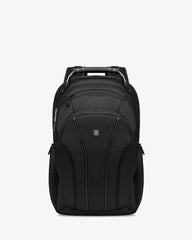
The Urban Backpack is listed at 11.8 by 5.9 by 18.1 inches, 19 liters, and 2.56 pounds. Its 180-degree full-opening main compartment provides suitcase-style access without turning the bag into a large one-bag travel pack.
It includes a padded sleeve for laptops up to 15.6 inches, S-shaped air-cushion straps, a concealed quick-access pocket, and a water-resistant twill nylon exterior. A rear strap is designed to secure the backpack to LEVEL8 wide-handle luggage, which is helpful for travelers alternating between shoulder carry and rolling luggage.
The 19-liter capacity makes it better for technology, documents, and daily essentials than for a clothing-heavy multi-day trip.
Best for laptop organization: Atlas Laptop Backpack
Atlas is at 12.6 by 6.5 by 18.6 inches, 31 liters, and 3.33 pounds. An independent compartment uses 3D EVA foam padding for laptops from 13 to 16 inches, while 26 organizer pockets separate cables, travel documents, small accessories, and personal items.
The larger main compartment can hold light clothing, making Atlas more suitable than Urban for an overnight work trip. Its additional capacity and organization also create more empty weight, so test the bag with the equipment you actually carry.
Travel Backpack vs. Carry-On Suitcase
The right luggage format depends on where the weight is easiest to manage. This comparison shows when hands-free carrying helps and when moving the load onto wheels is the more comfortable choice.
|
Travel condition |
Backpack may be better |
Rolling suitcase may be better |
|
Stairs and public transit |
Keeps both hands free |
Requires lifting at stairs |
|
Long airport corridors |
Load stays on the body |
Spinner wheels reduce shoulder load |
|
Rough streets |
No small wheels to catch |
Must be lifted or pulled carefully |
|
Wrinkle-sensitive clothing |
Less structured packing |
Flatter interior can protect folded clothing |
|
Laptop access |
Dedicated compartment can be quick |
Depends on external compartment or separate bag |
|
Heavy load |
Can strain shoulders and back |
Weight stays on wheels on smooth ground |
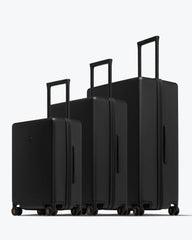
Travelers who want a daypack at the destination may prefer a backpack plus suitcase. An Urban Backpack paired with a Voyageur Carry-On separates accessible technology from clothing while allowing the backpack to attach to the suitcase's wide handle.
How to Check Backpack Fit Before Traveling
Load the backpack with your laptop, water, chargers, and the clothing you expect to carry. Tighten the shoulder straps until the bag sits close to the back without pulling the shoulders backward.
Walk, climb stairs, sit down, and reach for the items you need most. Check for pressure at the neck and underarms, excessive movement, and a bag body that extends uncomfortably beyond the torso. If the discomfort appears within a short test, it is unlikely to improve during a full travel day.
What Size Travel Backpack Should You Choose?
Capacity provides a useful starting point, but it should be considered alongside external dimensions and loaded comfort. The ranges below describe common uses rather than guaranteed airline categories. Before choosing the final size, use a travel packing list to estimate the items the backpack must actually hold.
- Under 20 liters: Daily city movement, commuting, and a compact personal-item setup.
- About 20–30 liters: Overnight trips, light weekend packing, or business travel with a laptop.
- About 30–40 liters: Multi-day one-bag travel for disciplined packers.
- Above 40 liters: More capacity, but increased risk of excessive weight and carry-on incompatibility.
Capacity is not an airline category. Always compare the backpack's full external dimensions with the carrier's rule.
Final Recommendation
Choose the Urban Backpack for compact city travel, commuting, and light technology carry. Choose Atlas when laptop protection, organization, and room for an overnight trip matter more than minimizing size and weight.
If a fully loaded backpack feels uncomfortable, do not force a one-bag strategy. A rolling carry-on plus a smaller backpack can be the better travel system because it moves clothing weight to the wheels while keeping essential items accessible.
FAQ
What size travel backpack is best for women?
The best size depends on torso proportions, carrying comfort, and trip type. A compact pack may be more comfortable for daily travel, while 30 liters or more can support overnight or multi-day packing.
Are women-specific backpacks necessary?
Not always. Women-specific suspension can help some users, but a well-fitting unisex backpack may work equally well. Test strap shape, torso length, and loaded comfort rather than relying on the label.
Can a travel backpack count as a personal item?
It can if its full dimensions fit the airline's current personal-item allowance. Capacity alone does not determine compliance.
Is a 30-liter backpack enough for a weekend trip?
For many light packers, yes. Weather, shoes, electronics, and toiletries can change the amount of space needed.
Is a backpack or rolling suitcase better for international travel?
A backpack is convenient for stairs and public transportation, while a rolling suitcase reduces the amount carried on the body. Choose according to the route and realistic load.
How should a travel backpack fit a shorter torso?
It should sit close to the back without extending so low that it interferes with walking or so high that it pushes toward the neck. Testing the loaded bag is more reliable than choosing by liters alone.
Leave a comment